
Uptime
Is it up? Your own sites, servers and services, checked from your machine, with a popup the moment one goes down
 von @PleasePrompto
Screenshots
README
Uptime
Is it up? Your own sites, servers and services, checked from your machine every minute, with a popup the moment one goes down and another when it is back. No account, no API key, nothing leaves your computer except the checks themselves.
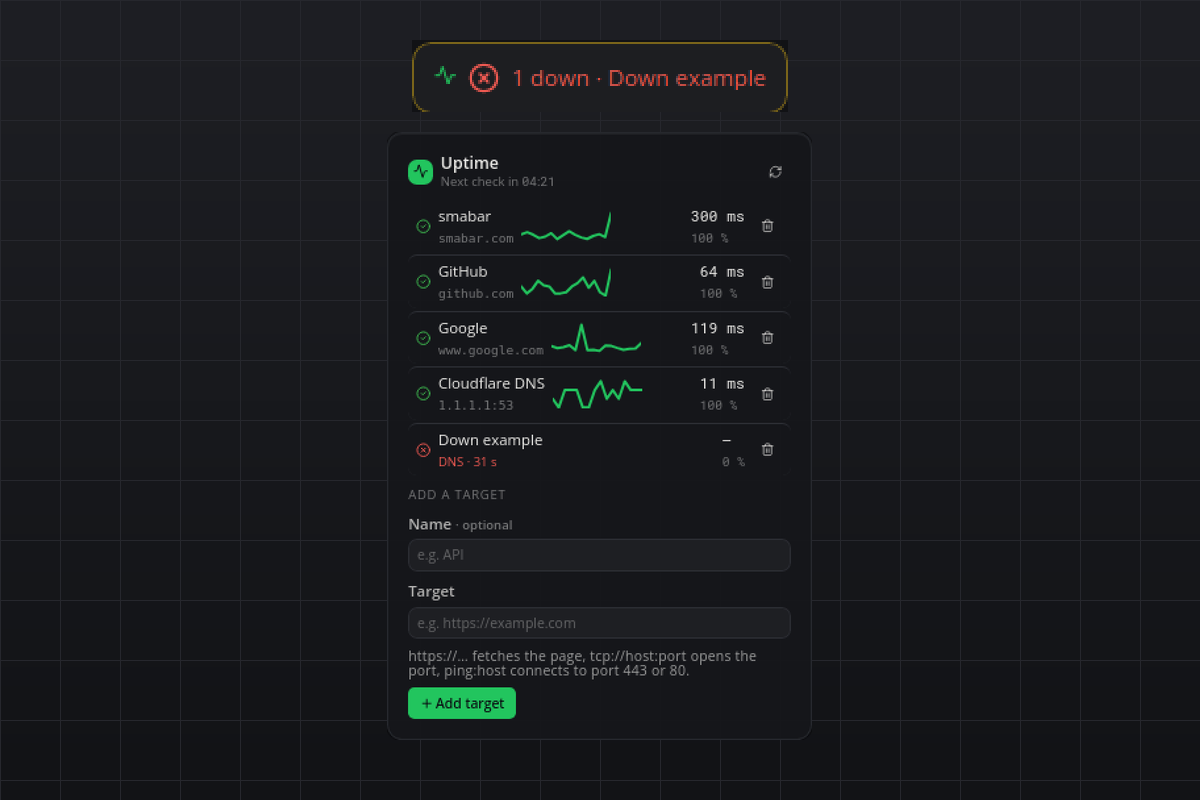
What you see
- Tile:
8/8 upin green with a check mark, or1 down · apiin red with the names of the targets that fail. Without targets it says "Add targets". - Flyout: the next-check countdown and a Check now button in the header; one row per target with its status icon, name and host, a sparkline of the recent latencies, the latest latency and the uptime percentage, and a Remove button. A down row shows the reason instead of the host:
HTTP 503,timeout,DNS,refused,TLS, plus how long it has been down. Below the list a small form adds a target. - Hover: one line per target with its latency or its failure reason, at most five.
- Popup:
Down: api (HTTP 503)after the configured number of consecutive failures,Back up: api after 4 minon the first success afterwards. Both carry a Check now button. The first round after a start never pops up; it only shows the state.
Targets
One entry per target, as Name | target or just the target. The name defaults to the host.
| Form | What is checked | Up when |
|---|---|---|
https://… / http://… |
A GET request with a smabar-uptime User-Agent, following redirects; the body is not downloaded |
the final status is below 400 |
tcp://host:port |
A TCP connection to that port | the connection opens |
ping:host |
A TCP connection to port 443, then 80 | one of the ports opens |
ping: does not send ICMP: raw sockets need privileges on every platform, so the plugin connects to the two ports almost every host answers on. A host that blocks both counts as down.
HEAD requests are deliberately not used because many hosts reject them.
How it works
- Every
intervalSecondsall targets are checked at once in a small thread pool, each with atimeoutSecondslimit; the latency is the full round trip. - Each target keeps a ring buffer of the last
historySizeresults (time, ok, latency, code). The uptime percentage is the share of successful checks in that buffer; the sparkline plots the latency of the successful ones. - A target becomes down after
failuresBeforeDownconsecutive failures and up again on the first success. The state change time is kept, so "back up after 4 min" measures the whole outage from its first failed check. - The buffers and states are written atomically to
state.jsonin the plugin's data directory after every round, so a restart shows the last known state immediately.
Agent commands
status lists every target with state, latency, uptime and the time of its last state change. check runs a round now (optionally for one target by name) and returns the results. add (name optional, target) and remove (name) edit the target list; they validate the target form and refuse duplicates.
Settings
| Setting | Default | Meaning |
|---|---|---|
targets |
[] |
The targets, one string each: Name | target or just the target. The flyout edits this list. |
intervalSeconds |
60 |
Seconds between rounds; the minimum is 15. |
timeoutSeconds |
5 |
Seconds a single check may take before it counts as a timeout. |
failuresBeforeDown |
2 |
Consecutive failures before a target is down and the popup appears. |
historySize |
60 |
Checks kept per target for the uptime percentage and the sparkline. |
An entry the plugin cannot parse is skipped and listed in a warning at the top of the flyout.
Privacy
The plugin only ever contacts the targets you configure, from your machine, with a User-Agent that names the plugin. Results stay in the plugin's data directory.
Known limits
- Checks run from this computer: a target that is down for you may be fine for others, and a sleeping laptop checks nothing.
ping:is a TCP connect, not ICMP.- HTTP checks look at the status code only; a page that answers 200 with an error message counts as up.
- Latency includes DNS resolution and the TLS handshake.
Development
python3 test_checks.py runs the parser, ring buffer, state machine and markup self-check without a running bar and without network access.
#uptime #monitoring #status #ping #http #latency #alerts #self-hosted
gelistet von main bei d4b430c83abc, aktualisiert vor 3 Tagen